Author: Stephen

  • An unforgettable greeting

    Hello from Baie de Taiohae! Flyer and her crew of five souls arrived here safely yesterday, Saturday March 14 at around 5:30p boat time (PDT) or 3pm local time (GMT -9:30).* Yes, optimistic Paul did win the arrival pool and with it he chose to disburse some bars of Theo Chocolate among the crew. 

    Since the last update, our remaining miles under sail were enjoyable and swift. We were fortunate to have a fresh easterly trade wind that pushed us along at an average of 6.5kn. As dusk fell on the 13th it appeared the breeze was freshening, so we tucked in a 2nd reef in the main and braced for more action. It was not to be, so by midnight we shook out both reefs and powered Flyer up to full speed.

    We sailed at a great pace, swapping the genoa for the A3 at 11am. It was great to get that sail up in the air (and sun) since it had spent the prior 48 hours lashed to the foredeck getting absolutely drenched by the swells coming over the deck. It also made for a picturesque scene on deck, Flyer under full canvas as the first sights of land were spotted; first it was the island of Ua Huka and a couple of hours later the foothills of Nuku Hiva became visible beneath the low clouds surrounding its shores.

    As if on-cue, a pod of porpoises welcomed us, and the boys and I sat on the bow together to watch them play with the dramatic cliffs of Nuku Hiva just to leeward of the A3. It was a scene and feeling I won’t soon forget.

    Flyer made great mileage until we were within the geographic effect of the islands, around 5nm offshore. We made a few final underway calls to family before deciding to fire up the engine one last time just before 4p boat time. The breeze continued to die and the seas around us turned into a veritable washing machine. The near vertical coastline of the SE coroner of Nuku Hiva sends ocean swells rebounding offshore and, mixing with the already somewhat jumbled seas from storms far away and making a pretty nasty few miles before reaching the anchorage.

    Under power we were all business beginning the slow process of furling and stowing sails, coiling lines, and preparing the boat to anchor. Kristen was working the remaining bits of spray-foam insulation out of the hawse pipe for the anchor chain as we approached Taiohae bay when all of a sudden a speeding RIB buzzed us with none other than King Neptune himself at the helm! He congratulated us on our passage and tossed celebratory packets of Skittles aboard while his friends Paul and James hooted and hollered at the sight of another human soul, their good friend Griffin Barckert nonetheless!

    We followed Griffin into the anchorage and buzzed his famous boat Rocket Science to say hi and gain anchoring tips from his parents Mara and Greg. We found a nice spot just a couple hundred yards east of them, dropped the hook and with their help set a stern anchor to keep our bow facing south and the incoming swells. (The common easterly breeze in the harbor has a tendency to keep boats facing east, making a monohull like Flyer roll considerably in the southern swells.)

    Mara, Greg and Griffin all came aboard and after copious hugs and giddy smiles presented us with a basket full of local bounty, a 6-pack of cold Hinano (the local Tahitian lager), and fancy, printed certificates from King Neptune congratulating us for our passage! Sitting in the cockpit together, Mara read us a poem she wrote for us to commemorate the occasion. We were all a bit teary eyed realizing what we had done together and how special it was to celebrate together with such wonderful friends in our new, spectacular setting. 

    Just a portion of the lovely bounty brought by the dear Rocket Scientists. Alongside the banana and passion fruit in the basket of palm made by Mara is a famous Breadfruit! Coconut and pamplemousse too!
    4/5ths of your crew enjoying a celebratory swim in the bay. Flyer’s buddy boat Rocket Science is seen here to the left in the distance.

    Pelle was thrilled to be on the decks once again and made her way to her favorite spot atop the mainsail on our boom. It’s hard to imagine what is/was going through her mind, but we can only imagine that she’s smelling new, curious smells and aware that we are now in a place that’s a little different than Baja.

    Now that the passage is behind us, I think I can say with certainty that it was a success and exceeded my expectations. We were fortunate to have decent conditions most of the time, exceptional conditions for some of the time. There were no major gear failures. The crew was generally in good spirits and healthy throughout. We landed several bucket-list fish, basked in the wonder of the cosmos, and we all stayed on board! We even had one remaining crunchy apple when we arrived. Not bad for 3,000nm across the Pacific.

    We’ll be settling into island cruising mode here over the next few days and will send an update when we’ve had a chance to get through a few of the formalities (namely checking in to country), go grocery shopping, and getting a better lay of the land. Until then, thanks again for reading and commenting -it’s been so fun to know you all have been with us all along!

  • Pedal down

    Hello from the good ship Flyer here on the Southern Seas, now just under 200nm NE* of the French Polynesian island of Nuku Hiva! Since we last checked in all five souls aboard are doing well, if hot. Temperatures have surprisingly not surpassed around 85degF since crossing the equator but the humidity has not dipped below 80%. As described previously, that means that things aboard are uncomfortable at best, and downright gross more often. 

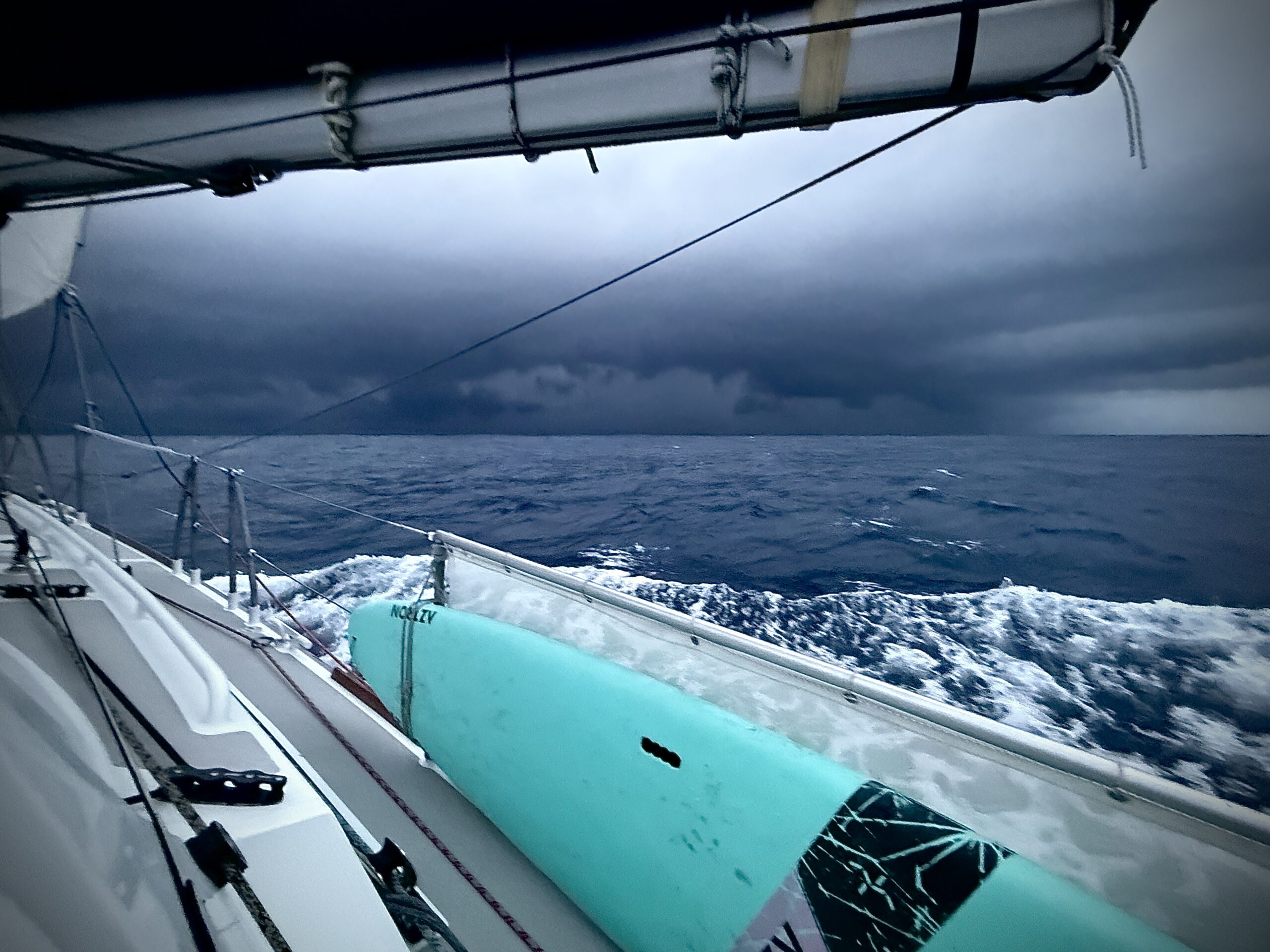
    The southern tradewinds have freshened beyond forecast. We are now seeing winds between 18-26kts from a bit further south than we had anticipated, so we are sailing a close reach into some choppy, confused seas. We’re moving at a faster pace as a result, but the boat is very wet on deck now so most hatches are closed and things are getting stuffy. And yet somehow my hot cup of Lighthouse coffee remains a highlight of my day!

    It also might appear that Flyer’s had some Lighthouse caffeine too lately. With the increased breeze also comes the opportunity for more miles, so we’ve been pushing her a little harder every day as our comfort with the conditions and sail combinations grow. And knowing we’ve got less than 200nm to go, we feel more eager than ever to put the pedal down!

    Since transiting the equator in the early hours of Tuesday March 11 we’ve enjoyed Kristen’s Bolognese, groomed Pelle with the ‘furminator,’ closely cropped dad’s hair and beard to a much more sensible length, successfully dodged several squalls, swapped the A3 and genoa out for each other over a dozen times, and debated whether our family will soon hold the record for most consecutive days at sea among our immediate, living family.

    The twenty-first full day of our passage means that we’re really really really looking forward to making landfall and all that might await us in French Polynesia. We’ve traded the enjoyment of every day life at sea for a palpable sense of ‘when will we get there, dad?’ Maybe it’s just the duration of the trip, or possibly it’s the second wave round of betting that has our best guesses of arrival time stickied to the chart in our cabin. 

    For the record, in reverse chronological order, we have James at 2p, me at 10:10a, and Kristen at 5a all on Sunday Mar 15 (the Ides of March!). Paul stands alone on March 14 at 10a. What’s your guess, dear reader?

    Arrival pool post-its committed to the chart in our cabin
    Conditions were a bit more moderate yesterday 3/12 and offered some time on the foredeck and coach roof to appreciate our unique surroundings
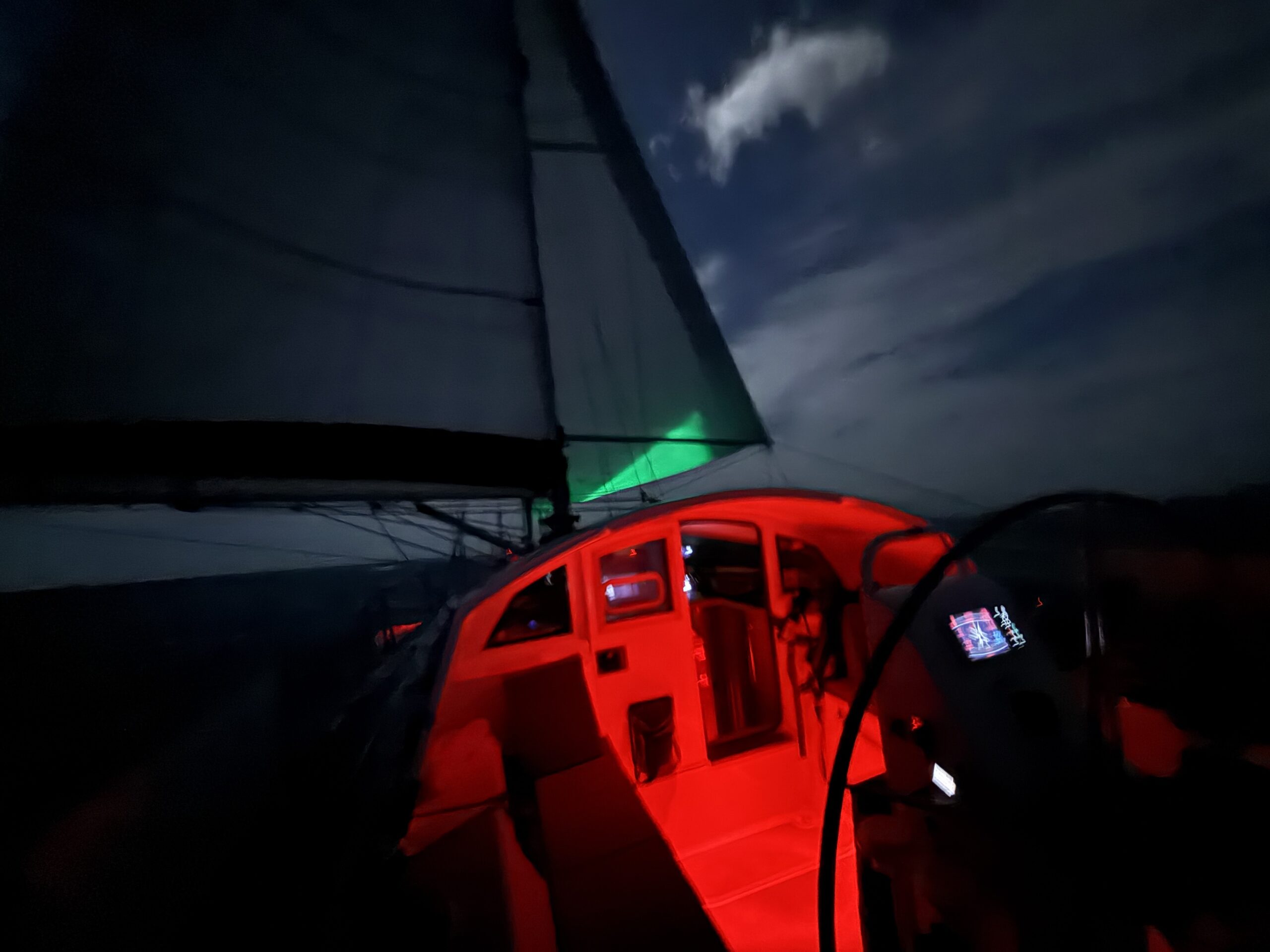
    Dusk in the cockpit 3/12
    A new pose from Pelle, one we believe may have something to do with her core temperature rather than her usual desire to be silly

    __________________________

    * Apologies, my original posting said NW of Nuku Hiva, not NE as it should have. Sleep deprivation taking its toll!

  • The Southern Hemisphere

    The Southern Hemisphere

    Hello from the other side of the globe! At around 4am boat time (also PDT) Flyer and her crew of 5 crossed the equator. Muchos muchos gracias again to King Neptune for delivering us a safe and enjoyable passage to this point, now zero degrees and 42 minutes into the southern hemisphere.

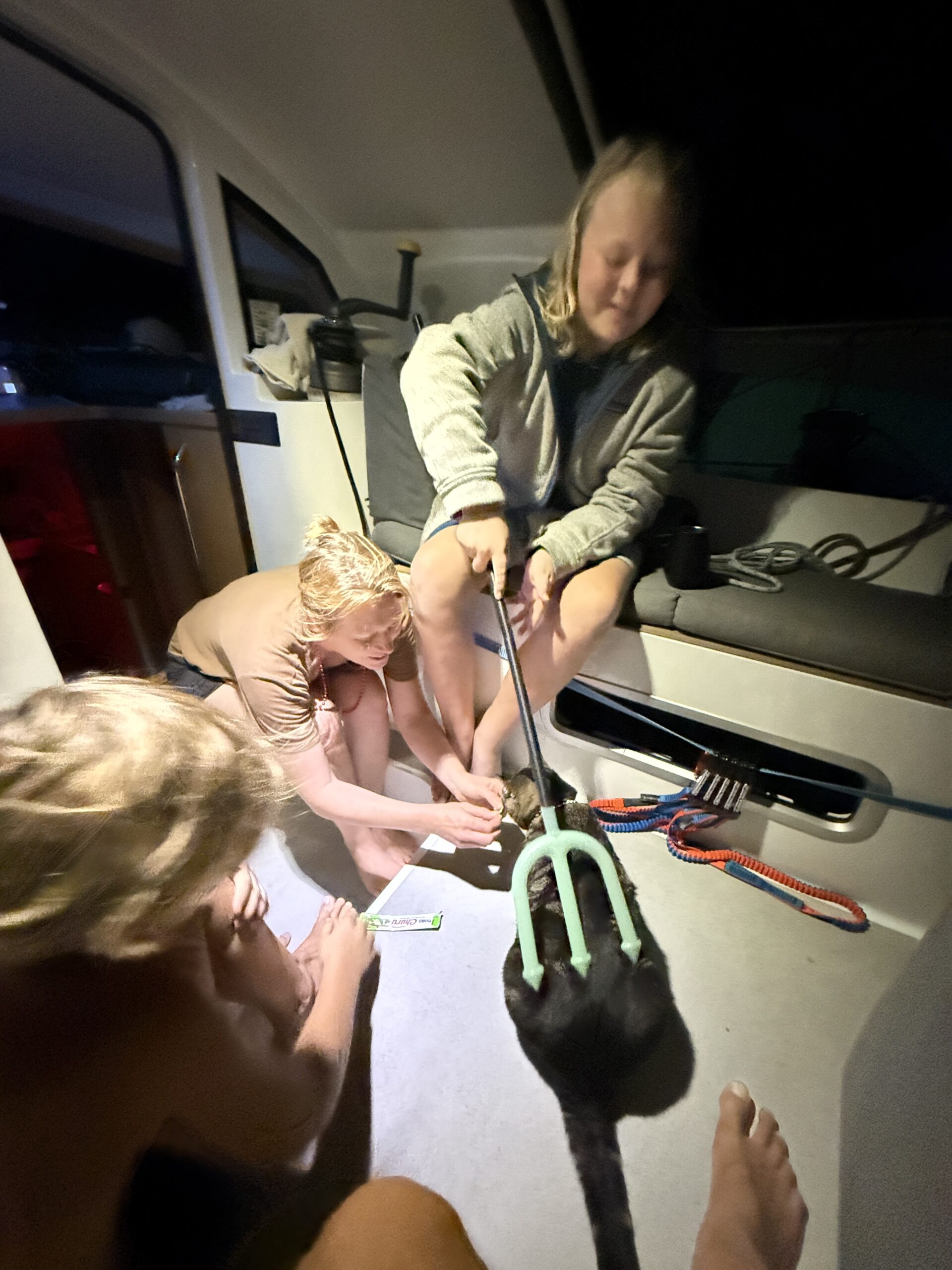
    Kristen was on watch at the time, and woke me to begin the festivities. I greeted the boys and Pelle with beads and my Neptune trident (thank you Kevin!) and we assembled in the cockpit with some chilled San Pellegrino and a leftover bottle of Kirkland Prosecco from Preston’s birthday party back in Bahia de los Muertos.

    On deck, the scene was spectacular. We had the remnants of the big dipper behind us, and the southern cross dead ahead. And about 30 degrees above the horizon on our windward or port side was half-moon lighting the ocean.

    It’s a long held seafaring tradition to commemorate the equatorial crossing with some antics. And in our family, no major event or experience happens without some sort of commemoration involving Pelle. So the ship’s cat was again feted, this time with beads and a couple of her favorite treats- the aptly named ‘squeeze-ups.’ We poured a good half-bottle of prosecco overboard for our protector, said a few important words, and marveled at the chart plotter when it went from reading our latitude from North to South.

    Unfortunately given the hour, poor lighting conditions, and overall sluggishness of the crew, we didn’t get many pictures, so those below will have to serve as proof of the festivities.

    We always enjoy a good mise-en-scene, so here’s a picture of a picture of our position when crossing.
    We were all in awe of the majesty of King Neptune.
    James performing King Neptune’s blessing on Pelle, who -like the rest of us- went from pollywog to shellback in an instant early this morning!
    Celebration time!

    Admittedly, as a sailor I’ve not really thought nor cared much about an equatorial crossing. It’s just a line on the globe, and it’s the other intangible experiences and elements of life on the ocean that mean more, right?
    But life at sea is a funny thing, and when you’ve been out of sight of land for as long as we have (eighteen days as of today), milestones like this make a big impression.

    Now having experienced it, I feel I better understand the hoopla behind crossing the equator on a boat. My brain has been eyeing that line on the chart for a while, knowing it’s both an important marker of our progress and a significant celestial and seasonal boundary for our life on earth. We went from spring to fall in the blink of an eye! Our days are now getting shorter by the day just when they were getting longer! The weather systems swirl in the other direction! It really does feel like we are on the other side of a major milestone.

    And so we find ourselves today very blessed to have favorable winds here at this point of the globe. We currently have a solid 12-15kn easterly breeze, very welcome to this crew after the light and unsettled conditions we experienced for several degrees north of here. While we’re bummed to miss out on swimming in the equatorial doldrums while becalmed, I , for one, am thrilled to be moving forward at a good pace instead!

    Despite feeling a bit sluggish this morning, Flyer’s crew has the boat going nicely in the delightful 15kt easterly breeze that King Neptune has given us here in the southern hemisphere.
    Paul seen here sharpening the hook of one of his trusty 6” cedar plugs. While we still have a good amount of fish still in our freezer, we’re hoping for some tuna for poke bowls soon! GO PAUL!
  • Hot in Herre

    Hot in Herre

    A common sight in the last few days. These squall cells are challenging to predict and proving impossible for Flyer to avoid.

    Good afternoon from the equatorial Pacific Ocean! All is well aboard the fine yacht Flyer as the past three days have passed with lots of action, preventing boredom and keeping us on our toes. After two or so days of breezy northeast trade wind sailing between 12n and 10n, we took a minor left turn three days ago at 10n 130w to make a more southerly course towards the Marquesas. 

    That left sent us into an area of greater atmospheric instability to the south. Within a half of a day we were confronted with our first squall of the trip. The dark cloud ahead also read loud and clear on our radar, and try as we might to head up and pass it from behind, the dark hovering monster only decided to grow unpredictably and envelop us entirely in its grips. 

    Within fifteen minutes the breeze jumped quickly from 15kn to 35kn. Flyer took it in stride, considering we had both a full mainsail and genoa up! We quickly eased the main to bear off to run before the push, and as we unloaded the sails we furled a half the genoa. The rain was tremendous, the heaviest rain we’d ever seen on Flyer. Within ten minutes the wind moderated to about 25kn for the remainder of the squall and and hour later, on the backside of the cell the wind had further moderated to 15kn.

    We had learned an important lesson. We needed to set the boat up better and more conservatively for the impending unpredictable squalls ahead. So a couple hours later, with nighttime setting in, we decided to drop the mainsail entirely as we saw another approaching dark mass. This proved a workable solution for the night, though as we soon learned, it was a bit too conservative. 

    The squalls that night were mostly lighter in nature, one of which even featured a fully becalmed center. After a long night of almost constant sail trim adjustment to keep Flyer moving, we were exhausted. As the dawn broke, we raised the mainsail again but this time with two reefs tucked in, reducing the sail area by over 1/3rd. This combination proved a good one for the next 48 hours, giving us enough power in the lighter winds to keep moving, but reducing our sail area enough to ride out the big gusts. 

    We’ve generally been sailing with this setup for the past two days, with eyes glued to the horizon and radar. We adjust our sails and trim accordingly, and always trying in vain to head up or down in an attempt to avoid them. We’ve found these storm cells to be very dynamic, sometimes materializing quickly in front of us, sometimes growing in unexpected directions, and always configuring themselves to be unavoidable for Flyer. 

    Life aboard has also become dramatically more wet. Flyer is a remarkably dry boat compared to most sailboats, but it’s easy to make life in the cabin wet when you’ve been caught off-guard by a squall with your hatches open! The heat and humidity are oppressive here in the intertropical convergence zone. Cabin temperatures have ranged from 82 to almost 90 degrees with humidity levels between 75-85%. Every surface feels wet to the touch. Our sheets and clothes have become adhesives. Sometimes keeping hatches open is a gamble we’re willing to take given how quickly the air inside our cabin gets hot and stuffy.

    Another not-so-welcome guest aboard Flyer have been the gooseneck barnacles we’re seeing adhered to our transom. These are weird looking creatures that hitch a ride on slower moving boats through the tropics. On sailboats like Flyer, they quickly adhere themselves and grow all over the hull and increase the boat’s drag through the water, slowing us down. Some have said they can cut a boat’s speed in half when they have matured and populated to a certain extent. To combat the gooseneck barnacles we are dragging a coarse, 5/8” line off the bow for about an hour every day. This line drags along the hull and (hopefully) with the motion of the boat through the water, helps to knock some of the creatures off. Time will tell if this has helped, but it can’t hurt to try, no? Rumor has it that within 24 hours of arrival in the Marquesas, the local fish provide a complementary hull-cleaning service. We are looking forward to that.

    As I finish writing here in the doghouse the skies ahead are blue with only occasional small puffy clouds overhead. Flyer is sailing happily at a course of 195degrees magnetic at 6.5 to 7.5 knots under the watchful eye of Piloti, our newly trusty Windpilot. I made a few adjustments to the system and, with the right sail combination and balance, Piloti is thrilled to take the helm for hours at a time to give his robotic counterpart a break. 

    It appears the next couple of days will bring more sun, fewer squalls, and, most importantly, some wind to take us across the equator, now only 198nm ahead. With 2,111nm down and less than 1,000 to go to Nuku Hiva, we’re amazed at how far we’ve come on this passage. “I can’t believe it’s been two weeks” James remarked a couple days ago. “It feels like it’s only been one!” I’ll chalk that one up for a win.

    In the tropics we spend may hours at night watching these red blobs grow and morph, usually in some form that fully encapsulates us on Flyer. I’ve found that when combined with sleep deprivation, radar-staring can be an enjoyable game identifying the likeness of the ever evolving forms. Here I was pretty sure we were sailing up into the armpit of a jumping rabbit.
    The double-reefed main that treated us well for a couple of days through unpredictable squalls.
    The small black things trailing behind Flyer’s aluminum transom are the gooseneck barnacles that we know are now taking hold on the hull below. They’ll slow us down but hopefully provide a nice meal for the fish in Taioha’e Bay.
    Our newly trusted crewmember Piloti, the Windpilot at work. It uses the vertical white vane element to articulate the pendulum rudder below which provides the power to turn the steering wheel with a couple of steering lines.
    Here you can see the white line (with red and blue fleck in it) running from the steering wheel hub, through a series of turning blocs, to the wind pilot pendulum behind Flyer’s transom. You also can see some of our laundry.
    A view from Flyer’s doghouse. It’s a great place to manage the boat from as we traverse the squalls, though it’s also REALLY HOT IN HERRE
  • Three favorite offshore upgrades

    Three favorite offshore upgrades

    Here are some thoughts about three projects or additions we made to Flyer prior to this trip that have made a big difference in our life offshore, particularly related to safety and comfort.

    The new solid rail and weather cloth just outboard of the cockpit on either side of the boat serves to keep us safe, dry, and less wind-battered than we’d otherwise be.
    1. Solid handrails and weather cloths on the after outboard stanchions. This was a pretty simple aluminum and sewing project that has ultimately made the cockpit a safer, more protected place to be.
      • The aluminum portion of the project was done when Flyer was hauled out at CSR in February of 2024. Nick Rudnick and his team at Rudnick MFG were great partners in a bunch of aluminum work we’ve done on the boat, and this might have been one of the easier projects, which gives it a high impact rating! We simply welded a 1-1/4” aluminum pipe on top of the last two existing stanchions and the pushpit. They form a solid, grab-able length of rail that was slightly higher than the previous lifeline and substantially stiffer and stronger.
      • The sewing portion of the project was done in the weeks preceding our departure in July of 2025 by Kristen on our beloved Sailrite sewing machine. The cloths that are suspended between the lifelines and rails are known as ‘weather cloths’ and were popular in the 1970’s and 80’s in offshore racing and sailing, as they served to keep the cockpit more dry and less battered by wind. Unfortunately they’ve fallen out of fashion but as we aboard Flyer are in no beauty contests, we’ll do what’s safest and most functional! Traditionally weather cloths have been made of marine canvas, but we chose to use Phiphertex, a strong coated nylon mesh fabric that breaks most of the wind but maintains some permeability for both views and water. If we’re hit by a really big wave, the Phiphertex will let some of the water through, absorbing the impact and lessening the possibility that the weather cloth will be blown apart. Kristen even added some pockets for our genoa and staysail furling lines on the port side.
      • The combined impact of the rail and the weather cloth has made the cockpit feel much more cozy and secure for us, and even gave us the opportunity to add more solar power to the boat, which leads me to our next favorite addition:

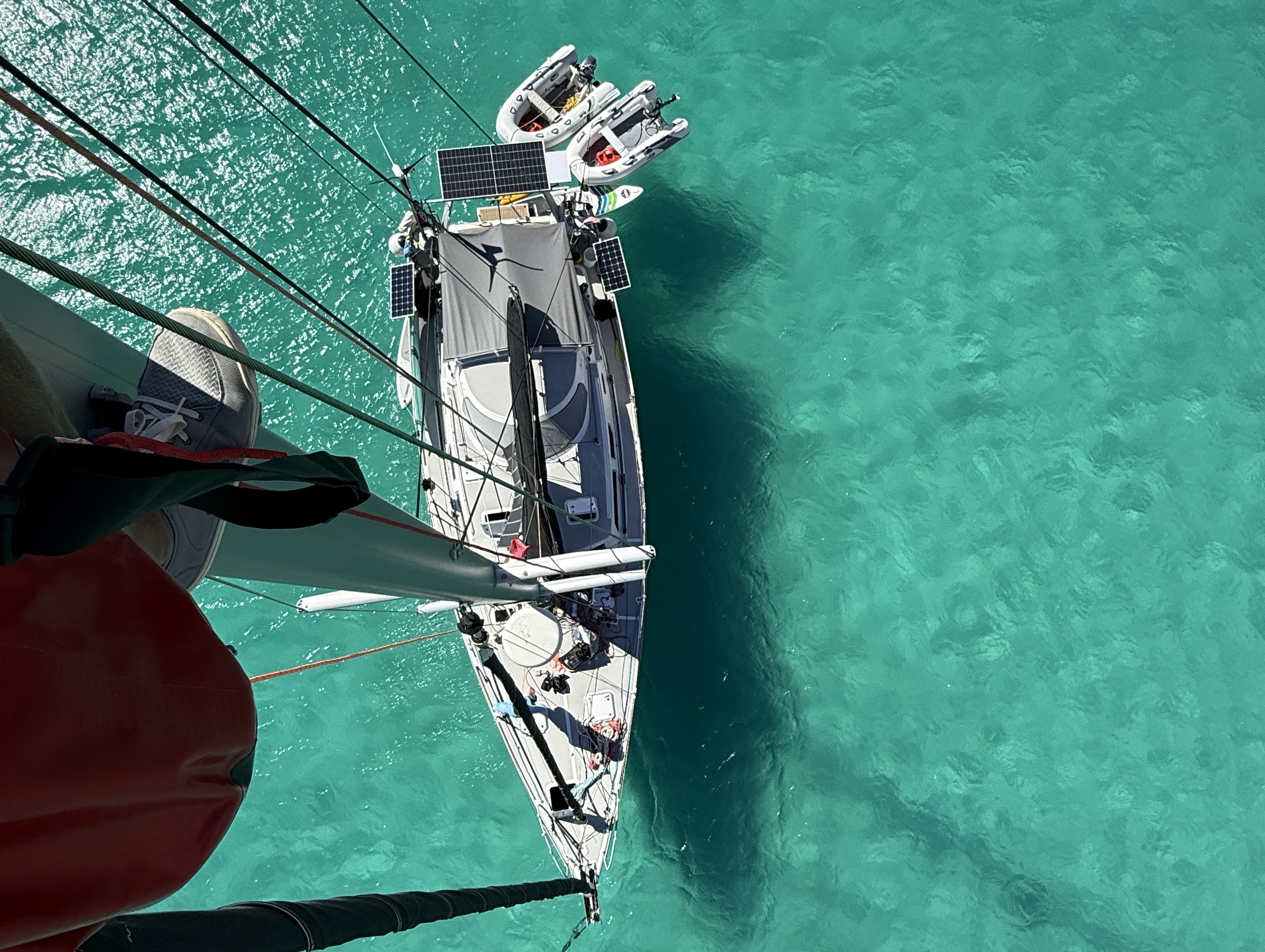
    Flyer’s solar array as seen from above. The 430w panel and two 100w panels surround the cockpit, and a deployable/folding 180w panel can be seen (barely) hanging on the starboard side of the boom here at anchor at Isla Espiritu Santo.
    1. More renewable energy sources. It cannot be stressed enough that more and diverse renewable energy sources are a must-have on an offshore sailboat. Flyer doesn’t have a generator, so when we’re sailing (and we don’t want the engine on) the boat requires some form of energy generation to keep up with our power demands. We lead a relatively modest energy existence on Flyer, but just the basics -navigation electronics, lights, watermaker, and refrigeration- require us to replenish energy that we use throughout the day and night. Flyer was originally built with only two sources of energy – a modest 200 watt solar array, and a SuperWind generator, neither of which were sufficient to supply enough energy for our needs. So in the past two years we’ve added the following:
      • Watt&Sea hydrogenerator- this thing is amazing. At speeds of 4 knots and above, we are able to generate a decent amount of electricity. When we reach 6 or more knots, it’s a wealth of wattage! Below is the power curve for the unit we have. With two different propellers (the 280mm and 240mm sizes) we can tailor the power output to our needs and speeds. And it will produce energy when other sources will not, particularly at night when going downwind, which is a pretty common situation for us!
    The Watt&Sea, shown here in kicked-up position awaiting duty. It is easy to service with its dinghy-rudder-like design. It pivots on the transom when deployed to allow the propeller to align with the direction of flow beneath the boat, which shifts dynamically as the boat responds to the sea conditions.
    • (apologies for WordPress’ horrendous formatting here but the outline format continues …)
      • Additional solar power- When it comes to solar power generation on a cruising sailboat, there’s no limit to the amount that’s right. Solar can be the biggest workhorse of the renewable family, given that most of our time on the boat is not spent sailing but sitting at anchor, when the Watt&Sea won’t give us any power and the SuperWind is hopefully not too active (otherwise we might prefer to find a less windy anchorage!). In 2024 we replaced the meager 200w array on the arch with a new 430w panel, and the new aluminum grab rails gave us additional real-estate to relocate the 2x 100w panels from the arch, to give us tuneable/rotating panels. The ability to articulate their angle drastically improves their efficiency, and these panels have greatly improved our energy generation since we added them in May of 2025.
      • We also added an auxiliary solar panel attachment point at the base of the mast, capable of accepting up to 200w of additional portable solar panels. We currently have 2x 180W folding solar panels that we use either one at a time (when it’s really sunny) or in tandem (when it’s overcast) to boost our generation. While we conceived of this auxiliary system to be used only at anchor, we’ve found times when sailing offshore that it can be really helpful when we need more power, such as a very light-wind streak when our speeds are consistently below 4kts.

    The preventer (shown here as a grey/pink line running forward on deck to the bow) leads from the cockpit forward to a low-friction ring on a bow cleat, where it is then led to attach to a long strop that runs from the boom end.
    1. Cockpit-led preventer system. This is probably the most important safety upgrade we made to Flyer, and certainly the cheapest of them all. The preventer system is designed to pull the boom forward and keep it from gybing accidentally. Accidental gybes are one of the most common sources of offshore sailing tragedies, and research has proven over the years that a fixed, low-stretch preventer system is the best way to combat them. It required only two simple permanent additions to Flyer’s deck plan (a Lewmar rope clutch on either quarter) and a series of removable low-friction leads. I also spliced a more permanently mounted ‘strop’ made of SK-98 low-stretch braided line, that allows us to attach the preventer leads to the boom while the boom is beyond reach. It’s important to have the preventer rigged at the end of the boom since that is where the loads on the line will be the lowest, and you’ll also have the least chance of breaking the boom if it drags in the water. And having the clutches within reach of the cockpit is really convenient which ensures they will be used and adjusted frequently!
    The black Lewmar rope clutch for the preventer is seen in the bottom left of the photo. To keep it in-line with the forces from the preventer line (grey and pink flecks line led to winch), we mounted it facing forward with a low-friction ring to improve the lead for line handling from the cockpit and allow us to snug it down it with a winch if desired.
    Here you can see the SK-98 strop (grey) from the left, connecting to a snap-shackle and then to the preventer line that leads from the low-friction ring mounted on the bow cleat. The snap shackle was a late addition to the system, but it’s really helpful since we are frequently disconnecting and reconnecting these lines to improve the sheet leads for our genoa, A3 and spinnaker as the sailing angles change.
  • Night Shift

    Night Shift

    04 March, 0320 PST approx 1,500nm NW of Nuku Hiva – Hello from the graveyard shift. As I write we are barreling along on a WSW course with solid trade winds behind us, with a full moon to light our way. Flyer has been keeping up a good pace in the last 24 hours, covering over 140 miles right on course, bringing our 11.5 day total to just under 1,500nm, which, depending on how you measure it, could be considered close to half-way to Nuku Hiva!?

    Life aboard Flyer has been enjoyable these past few days. With the boat moving comfortably along, we’ve been able to spend more time just witnessing life in the remote Pacific. Yesterday we were welcomed by a small pod of porpoises who came to play in our bow wave. Shortly after I noticed some leaping sailfish about a quarter mile away, hurtling themselves over fifteen feet in the air! 

    Within an hour, another massive pod of porpoises came barreling towards us from the south. They formed a thick frontal line as if they were hunting in a group, swimming at an impressive speed and jumping with great frequency. They sped right past us and were out of sight within a couple minutes, and the force of their collective rush was incredible to witness.

    There seem to be many more flying fish in these latitudes. Practically everywhere we look they are flying along, inches above the waves, before smashing face-first back into the blue. They’re so fun to watch, and currently in the lead as the boys’ favorite form of wildlife out here. 

    We had a bit of excitement this morning when we hoisted the A3- our reaching sail that we like to fly when the wind is between 5-20knots from between 70 to 140 degrees true angle (the angle of the true wind to the boat’s axis). The sail is set on the bow sprit just above our anchor roller, and it’s managed by a continuous-line furler that allows it to be wrapped up on itself like our genoa and staysail for easy deployment and dowsing. I had just hoisted it, and Paul was in the cockpit about to trim in the sheet to unfurl the sail, when I looked forward and saw the sail, its furler and furling line flapping wildly about downwind of us, not attached to the boat! And in seconds, the sail had mostly unfurled itself and was making quite a spectacle of us. 

    We quickly got some help from James on the bow and Kristen in the cockpit. Paul lowered the halyard to me and James while we gathered the sail onto the foredeck. Kristen managed the sheets and steered the boat to a lower course to reduce windage on the bow. 

    When it was all down and secured with a sail tie, I noticed the Tylaska shackle that’s supposed to be part of the furling drum was still attached to the bow, while the drum was in my hands, still attached to the sail. We quickly deduced that they had separated because the two small grub-screws that keep the threaded connection locked had somehow worked themselves free. 

    Without any replacement grub screws aboard my quick fix was to simply clean and re-fasten the threaded connection, this time with copious amounts of red loctite and as much torque as I could muscle. I’m hoping this holds for the foreseeable future, and at the very least we know now to be keeping a close eye on this part.

    Last night’s graveyard shift was graced with a total lunar eclipse! It began around the start of my watch at 0200 ship’s time (PST) and ended around 0500. With some scattered low clouds, it made for an eerie, haunted feeling on deck. 

    Sailing into the sunset yesterday evening 3/3
    The A3 sail seen here in better, functioning condition. The bottom right corner of the sail is the tack fitting which separated on us several hours ago just after the hoist.
    The separated furler and Tylaska shackle from our A3. The brown gunk is probably some old seizing compound that was easily removed with a wire brush before I soaked it in red locktite and torqued it back together.
    James enjoys sitting on the bow watching porpoises whenever they come along.
    While at sea we aim for a proper sit-down dinner whenever we can manage it
    We’re finally in a place where we can be thinking about some other upcoming milestones, namely our first equator crossing! We’ve surveyed the full crew and have placed our bets on the chart in the salon. James is really looking forward to an extended cruise obviously with his prediction being over a year out! He’s also chosen to represent his month day and year in French format. Stay tuned…
    Last night’s eclipse was hard to capture with the motion of the boat

  • All over the map

    All over the map

    A zoomed out view of where we have been, where we were about an hour ago 1600 PST, and where we’re trying to get to, and some of the anticipated navigation ahead.

    The last couple of days have gone by in a blur. Not that time has transpired quickly, just less coherently. 

    We’ll start with the sailing conditions which, if you’ve been following the tracker, have clearly kept us on our toes, day and night. Contrary to previous forecasts, the conditions have continued to be fickle at best. For the last 36 hours we have been teased with senses of a freshening breeze, only to see the wind speed drop precipitously minutes later. The wind direction is following course, as it usually does, and is swinging wildly through 70 degrees at times. The seas have continued to be confused, mixing seasonal NW swells with wind driven waves from every other direction. 

    It’s been really hard to keep Flyer going all this time. Just when we begin to get momentum and feel that we have sails trimmed to meet the conditions, things change almost immediately. We’ve put up virtually every sail in our wardrobe, only to conclude that the sail combination is wrong. It feels a lot like ocean racing, excepting we’re not in a race, right? 

    But in reality we have found ourselves in a race with the weather. The ridge of high pressure that initially gave us challenges after Cabo San Lucas over a week ago with light and shifty conditions has continued to expand and follow us westward. We’ve felt like we’re being chased by a gentle demon who enjoys watching us bob around in the windless blue. And we’ve managed to stay just ahead of the bad stuff, which is in some ways good (we have had some wind) and bad (we have had some calms). All the weather models have been showing that there are more consistent, 10-15kn breezes just a handful of miles ahead of us… and we’ve been struggling to catch up!

    An abstracted reprise of the last couple of days in which the gentle purple (light-wind) demon has been making life interesting.

    To make matters even more challenging, our mid-passage waypoint -established as the point at which we think we will enter consistent NE trade winds just north of the equator- has continued to be almost directly downwind of our location. Flyer does not like dead-downwind sailing if the wind speed is below around 15kn, so we sail ‘hotter’ angles to the wind, meaning we don’t point directly at the destination but closer to the wind, giving the boat a little more speed through the water and requiring us to gybe occasionally so we don’t stray too far from our desired part of the ocean.

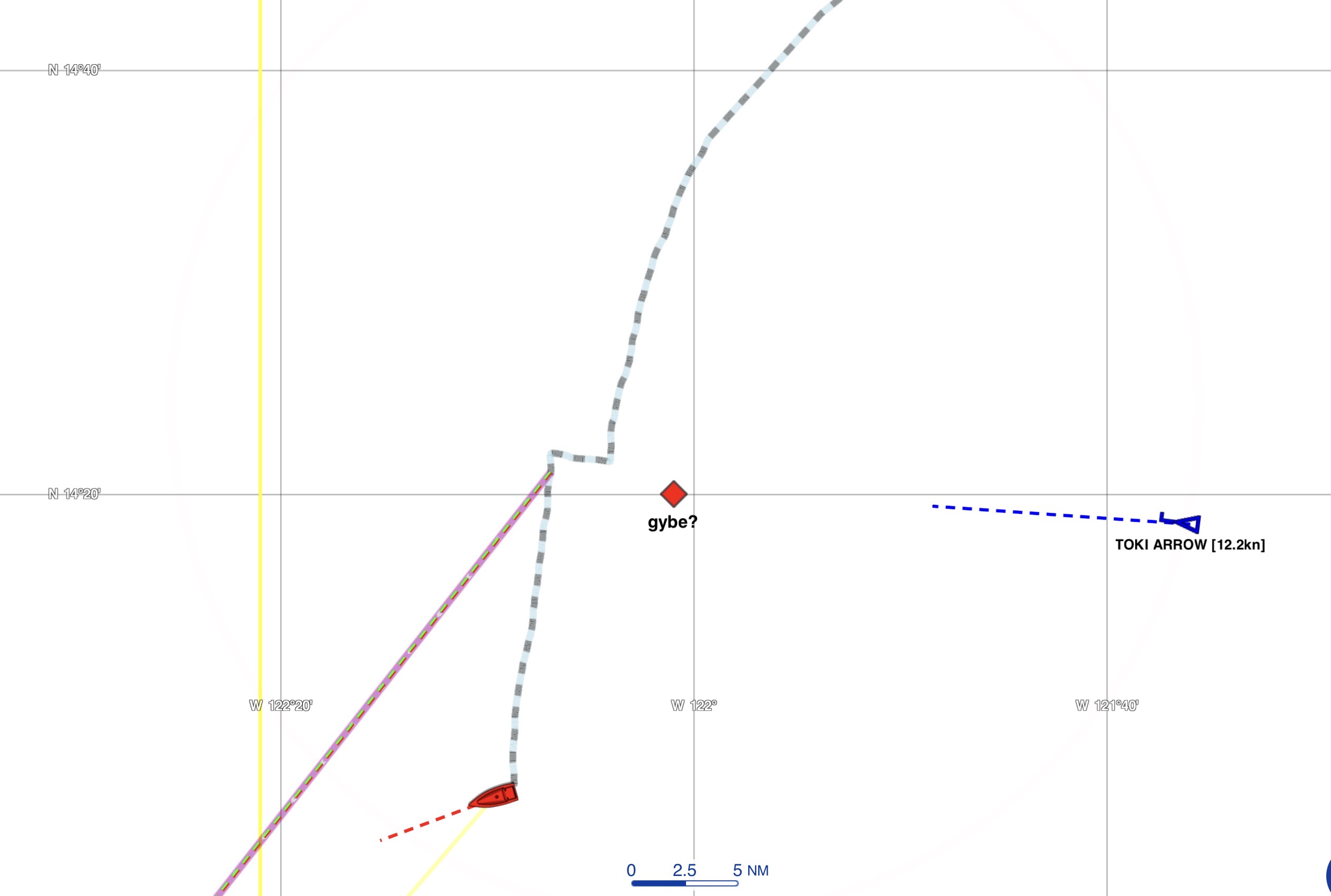
    A zoomed-in view of approximately the past 24 hours or so… you can see our course veering as the wind backed, and a few gybes that kept us working for it, every minute. There’s a diagonal purple line at the bottom left – that’s our current ‘desired path’ towards the tradewinds. You can also see a ship (TOKI ARROW) identified on web-based AIS, and a couple notes (yellow line indicating the longitude of our house, and a red diamond indicating where I thought we might gybe earlier today.

    These conditions mean that we are constantly reassessing both our sail combination/trim and whether or not we should be motoring. The latest outlook for the intertropical convergence zone (ITCZ, or doldrums) shows a bit more activity, and therefore potential for sustained calm, than we had originally anticipated. As a result we are saving our motoring for only our most desperate moments, like this morning around 0530 when we found ourselves becalmed after hours of very light-air drifting. 3 hours later we shut the engine down and found ourselves sailing again at a meager 3 knots, 30 degrees off of course. We’ll take what we can get!

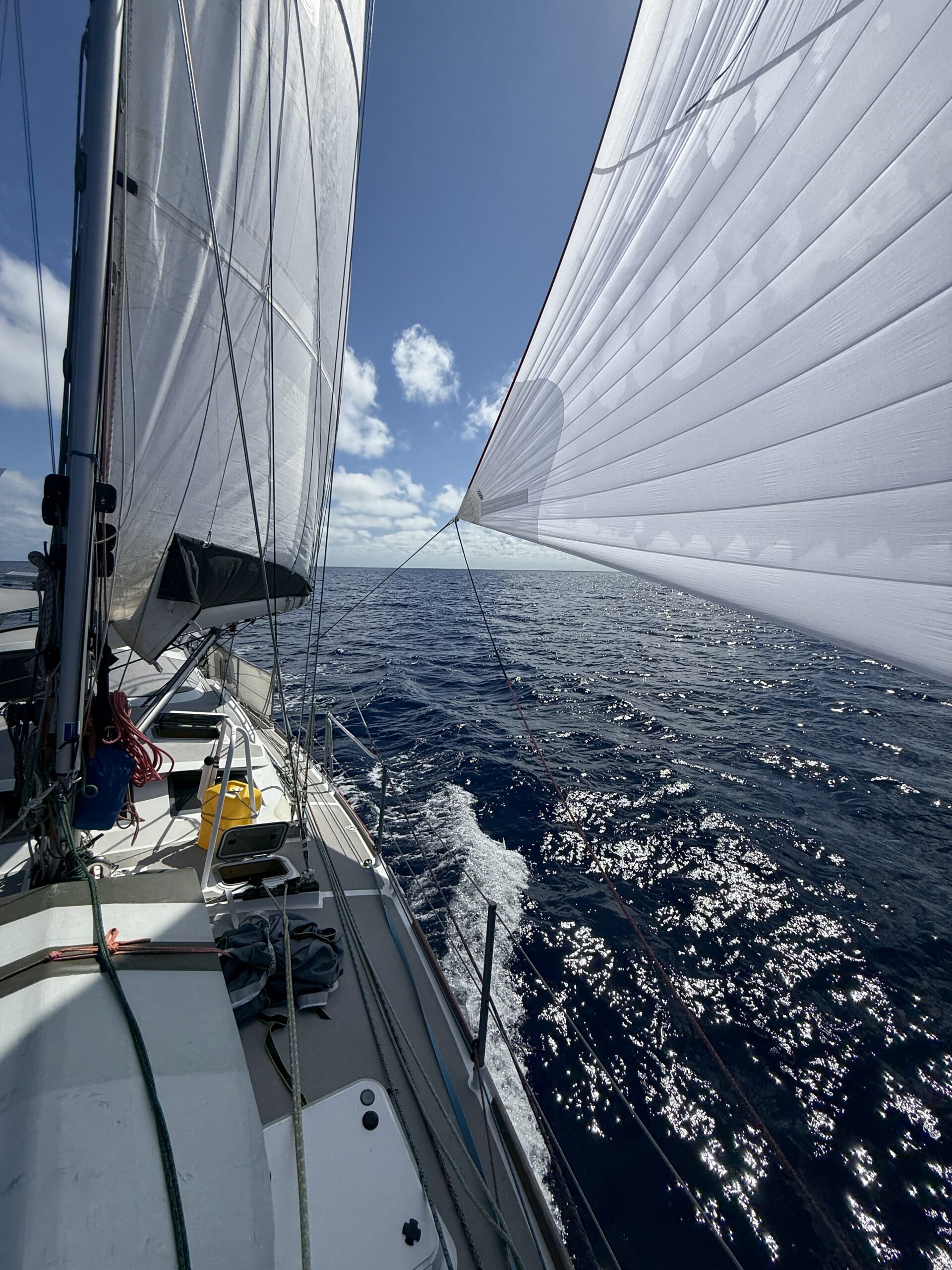
    We had the symmetrical spinnaker up for most of the day yesterday 2/28. It’s a pretty looking thing that is ugly to handle with a small crew like ours.

    Life on board suffers at times like these, or at least my perception of it does. I’ve not slept much recently, so Kristen and I have been flexing our watch times during the day in hopes of me being able to get a little more shut-eye during daylight hours. 

    The boys seem in a good mood nonetheless! Paul has been frantically thinking about the sailing dinghy of his dreams (a 29er) and as with all of his obsessions, he finds himself drawing that thing. James has been reading and, when the internet is on, connecting with his cousin Sam and school friends to play games together. 

    James also somehow just realized that his hair was too long -probably after discovering a rather large dreadlock-in-the-making- and promptly negotiated the grand opening of Kristen’s Aft Deck Salon.

    Anticipating an excruciatingly hot cabin in the coming week(s), Kristen has made the most of our oven and has roasted beets and baked focaccia recently. We’ll be having beet sandwiches for dinner tonight!

    To distract myself from the continued second-guessing, I decided to break out my guitar today. I think it’s the first time I’ve ever played it in the open ocean, and it gave me great pleasure. I was revisiting some of my favorite songs by Andy Shauf and the Beths. Maybe I’ll do some Led Zep tomorrow.

    The breeze seems to be slowly picking up now, so I need to get back to the sail trim. Thank you all for reading, it makes us so happy to know we can maintain a little connection with you all this far away from home.

    Paul drawing yet another 29er. He is quite the draughstman.
    This boobie paid us a visit two nights ago, and spent some time on our solar panel. He christened us with both the traditional boobie-poop, as well as a couple of regurgitated flying fish.
    Pelle sometimes enjoys hanging out in the cockpit cubbies when she’s on watch. I enjoy the company, though I don’t appreciate her repeated attempts at foredeck inspection.
    Today I felt a bit like David Brent.
    A rare moment of satisfying forward progress just minutes ago, 3/1.

  • Let us eat cake.

    Let us eat cake.

    27 Feb 19:50 ship’s time – 680nm SW of Cabo San Lucas — As I write we have succumbed to the calm and are motoring again. We’re moving along at almost 6kn with a very light northeasterly breeze behind us. We’ve had a tough and very light wind couple of days here, sticking to sailing through all of it. Conditions were decent at times, and downright miserable at others. Last night, starting just around dinner time, the sea state decided to get really ugly. It felt like we were bobbing in a bathtub full of gigantic toddlers.

    The commotion was so bad that despite the decent 12-15kn of breeze we had, the boat could hardly get moving through the friction of the disorganized waves. We stuck to our sails though, knowing that sailing was still possible, just slow and challenging. The motion in the cabin was so violent it was hard to even walk around, even with two hands on holds nearby. The seas finally abated by the early hours of the morning, and we kept sailing all day with a light northeasterly. It wasn’t until late afternoon today that we threw in the towel again and fired up the engine. Not a bad effort from the Flyer crew!

    With the quiet, light sailing today we were able to get through a few lingering maintenance items and boat chores. I spent an hour re-shimming the companionway door latch. I guess over the past few years the soft steel catch has been worn down and it wouldn’t hold when the boat flexed, and the bomb-proof aluminum door would swing wildly open as the boat heeled and slam against the opposite open side. Nice to have that one done!

    We also discovered today that with the significant increase in humidity out at sea, our freezing plates in our small refrigerator had iced-up much quicker than ever before. I discovered almost a full inch of ice coating the plates, which really reduces the efficiency of the refrigerator, something we care a lot about with our limited electrical energy aboard.

    As I usually do, I collected the icy chunks into a bucket and gave them to the boys to play with. This time they thought it would be best put to use cooling the ocean, so they threw blocks of ice into the big blue around us yelling “we’re trying to slow global warming!”

    Trying to slow global warming, one ice-cube at a time.

    We’re also using this engine time to make more water, and take advantage of the warm water we’re getting. Showers were had again, by most of us, and I took the opportunity to wash the salt off of our cabin house windows and port lights, as well as hose some more dried Mahi blood off of the cockpit floor with hot water. That stuff is pretty sticky, I have a feeling we’ll still be seeing remnants of that fish many months from now!

    As of 3:15p today, it’s been a week for us on this journey. Hard to believe, honestly, since it doesn’t feel that long to us right now. Unfortunately though, as you can probably tell, this week has been much slower than we’d hoped. We’ve covered 893 nautical miles in that time, which averages out to 127nm per day. Okay I suppose for a heavily laden 44’ boat, but a bit of a bummer to know we’ve also run the engine for 31.5 hours.

    Speaking of the engine, I think we have enough fuel aboard to power at a modest RPM for 160 hours. Conservatively, we really should only use 2/3rds of that. Converting that to miles, we’ve been budgeting around 600nm, or just over 100 hours of motoring at around 5.25kn. 600nm is 1/5th of the journey, which very well could have a lot more dead calm for us to deal with, and we’re really hoping to save our fuel for when we’ll need it the most!

    Even though it’s been a slow passage so far, we’re still really lucky we left when we did. The large ridge of high pressure that’s been chasing us since we rounded Baja 6 days ago looks like it’s settling in for quite a while, so any further delay in our departure would have probably meant waiting in Mexico for a better weather window… probably more that 2 weeks later!

    We just finished our taco dinner tonight (man we miss the real deal back in Mexico!), and the boys and Kristen are fixing to watch some more episodes of the Office while I stand watch on my early evening shift. Kristen just revealed a surprise cake, that she’s calling the “One-Week Cake,” in honor of this most momentous occasion. There’s a beautiful waxing gibbous moon out and it’s already pretty bright. I’m looking forward to another nice evening out here on the Pacific, even if we are motoring.

    Kristen re-racking the fridge after defrosting. James is seen here in the background working hard to keep Pelle pleased.
    Pelle enjoys helping with chores too, such as holding my multimeter and manuals down so they don’t fly off the bench when the boat rolls.
    Paul enjoys doing his online school time in the cockpit on nice sailing days like yesterday 2/26
    Kristen’s “One-Week Cake” for dessert tonight…mmmmm

  • Settling in

    Settling in

    25 Feb 1430 ships time – Somewhere west of Clarion Island.*

    We’ve been really lucky to have this northerly breeze continue at a higher velocity than forecasted. We only had one very light spell in the middle of the night last night and motored for about 3 1/2 hours. Kristen was below asleep when the breeze piped up to about 6 kn I promptly set the A3 again and we were off sailing. We’ve been sailing ever since the breeze has built since the early hours of the morning and we saw as much as 15 kn today around 11 AM ships time. 

    I was texting with Kevin aboard Dark Star (45nm behind us) this morning about how we are getting our boats to move better. It sounded like he had gotten his wind vane going nicely, but no success yet with a larger reaching or downwind sail. So he persuaded me to give our Windpilot another go and I convinced him to give that an asymmetrical spinnaker a second chance. He sent me a picture of his big-ass sail up a few hours later and seemed pleased with the results!

    On Flyer, our Windpilot proved tricky at a beam reach today. I think I need to adjust one of the servos in it so it can be more sensitive turning to port (it seems happy turning to starboard even with our mainsail luffing.) I’m also concerned that our solar arch creates a lot of turbulence for the wind vane element and makes it hard for it to be as responsive as it needs to be with the wind at this angle. We know other virtually identical Bóreals who are able to make them work well so it’s gotta be possible, right? I did get it going nicely for 10 to 15 minutes at a time this afternoon. I’ll give it another shot tomorrow.

    I rain in the water maker again today and finding our TDS (total dissolved solids) levels lower, which is nice to see. We’re getting readings of about 200ppm (parts per million) today.** Maybe the answer is more frequent use!

    Kristen and I regrouped today and confirmed that we’re doing OK with our four on, four off watch schedule. What it means is I have two 4 hour shifts at night and she has two 4 hour shifts during the day. (and of course that means we each have one 4 hour shift at the other half of the day.) Four hour shifts are nice because they give you time to get settled before going to sleep and some wiggle room in case you have trouble falling asleep, etc. Kristen says she’s getting enough rest but shes feeling a little under the weather with a minor cold right now. 

    I’m not sure if I’m getting enough rest. I seem to have contracted a splitting headache today, but I’m slowly figuring out how to do cat naps on my night watches which is nice to get a little bit more shut-eye during the dark hours. I’m not sure the two are related, but it would be good to have more motivation to get more sleep. 

    To be honest, my biggest fear is that sometime in the next few days one of us might contract dengue fever! We know it was going around in La Paz and really hope that we have escaped it. It has a 10 day incubation period… so here’s to continued decent health until at least March 2! 

    I took a shower last night on the deck after dark, and although it was hard to stand upright in the mild seas, it felt really good to be clean again! I think everyone else will probably shower in the next day or so while we have hot water from all that motoring. (We have a hot water tank that uses heat from the engine cooling loop to warm the water… depending on how much we use it can last up to three or four days). 

    Kristen made boat pizza last night and it was excellent. It’s basically a sheet pan pizza with lots of olive oil in it to help make the crust crunchy and she’s been making it on the boat for the last three or so years. It’s always a hit. We also had a salad. I wonder what we’ll have for dinner tonight? 

    We’re continuing to sail a bit north of rhumb line and it looks like that’s probably still a wise idea.  Given the latest GRIB files things seem to be looking a little bit better for the next few days than they were in previous forecasts earlier today and yesterday. The latest model run shows the breeze will be building tomorrow during the day with a couple minor dips in velocity, but generally it looks like it will be building to the midteens over the next five days! Most model runs show no motoring time for us over the next several days (a threshold I set in our routing software at a depressing minimum sailing speed of one and a half knots). Hallelujah!

    James continues his pattern of being the first one awake every morning and it’s so nice to see him come up on deck before the sun rises. The sunrises out here are pretty special and it’s nice to have someone to share them with. Pelle continues to be interested in coming on deck only when it’s dark out and bouncy! No Bueno Gato! as Kevin said. Paul continues to put lures out during the day but no bites in the last two days unfortunately. It would be nice to get another yellowfin to eat soon. 

    She looks a little grumpy here, but we’re pretty sure Pelle has been enjoying life at sea so far.
    Reaching along with the A3 up. Much to our disappointment we’ve found very few flying fish and squid on deck in the mornings lately. This is a trend we hope reverses itself very soon.
    Moon-set sometime around 3am, ship’s time. The iPhone’s low-light photography is impressive.

    * A note about these recent posts – I’ve gotten lazy and have been voice-dictating them to my phone when I get off watch in the afternoons. I’m a bit delayed in posting so this is almost a full 24hrs behind. Also, for some reason, the Apple Journal app likes to make some mistakes for me so some words don’t get transcribed well, and I’m not sharp enough right now to catch them all. Also, Journal also likes to make hyperlinks to random crap, and I’ve not yet caught onto that fully, so apologies for that garbage. Finally, WordPress has the most horrendous UI on an iPad, so we are constantly having challenges editing text (which seems like a pretty basic functionality they should have figured out). Apologies for the messiness but it seems the easiest way to share a bit of this adventure with you all every day.

    ** The World Health Organization has set a standard that anything below 500ppm is considered drinking water, so we have a bit of breathing room.

  • Carry on, it’s a marathon

    Carry on, it’s a marathon

    24 Feb 16:05 GMT -8 It’s so great to be sailing again. The last 24 hours have been pretty light, and the engine has been running almost continuously. We were in a calm for quite a while last night, and we motored through it all into dawn, which was glassy little bit of low, light fog, which looked beautiful on the water.  

    We continued motoring through the day today until around 2 PM when we were seeing puffs up to 6 knots. We promptly shut down the engine and set the A3. Since then the breeze has been building, to our surprise it’s now up to around peaks of 11 or 12 kn. We’re sailing along nicely at 6 to 7 kn. What a delight!

    Kristen and I were talking earlier about how it’s such a fine line between misery (motoring through the calm) and ecstasy (beam reaching on a gorgeous day in 12 kn of breeze) on a day like today. Sailing is such a funny thing sometimes.

    Our Watt&Sea Hydrogenerator is running nicely right now and giving us more than enough power to also make water. A couple hours ago I cleaned the seawater strainer and replaced the five µm filter, but unfortunately, the solids levels are still around the same, high 200’s ppm. Still good enough to drink, but a little annoying to see it creep higher. Maybe I should’ve run that cleaning cycle back in La Paz? Maybe we should just be running it every day? Maybe more use will make it better.

    Paul has three fishing lures out right now hoping for another tuna, this one maybe to keep for poke tonight. He pulled out a loose tooth today and after a quick celebration, decided to throw it into the sea for king Neptune.

    At separate times today, James and Paul were each stunned when coming on deck at the beauty of the blue ocean all around us. The color of the ocean this far offshore is probably the most beautiful color I can imagine. All oceans have a slightly different tint to them, some grey, some green, some black… but the deep blue Pacific here sure does remind me a lot of the Gulf Stream. 

    I’ve had a couple songs stuck in my head for the last few days both of them by Stephen Malkmus. Church on White and the subsequent song on his first record The Hook for some reason both feel very poignant right now on this passage.

    Evening of 2/23, barely a breath.
    Dawn 2/24 – remnants of a light fog in the distance
    It’s hard to sleep off watch when this one demands cuddling
    Green flash watch