We’ve now finished the last of three long, offshore passages: 22 days from Mexico to the Marquesas, 17 days from the Tuamotus to Hawaii, and 15 days from Hawaii to Alaska. Those weeks in the middle of the ocean are a little like sensory resets. Life shrinks down to the size of the boat. Outside water and sky are a spectrum of blue from black to white, occasionally warmed by the glow of a sunset.


Inside the boat, little things balloon: a freshwater shower is an event; a bag of Doritos is a celebration; the mystery of the awful smell near the refrigerator on starboard tacks is an obsession; a brother’s refusal to move his feet off the seat is the end of the world. With distance and sleep deprivation, memories of the last place fade. When the new place comes into view — new sights, sounds, smells, and temperature — it feels like a discovery.
Of the three passages, Hawaii to Alaska was the most extreme of these resets. And thanks to Cameron — the most positive, fun, helpful crew member aboard by miles — we actually had enough sleep to appreciate it all. After the early excitements of landing a tuna, seeing our first false killer whales, and swimming in the middle of the open ocean, life slowed way down. The switch from warm to cold was surprisingly quick, and with the cold weather, our living space shrunk even further. No more lounging in the cockpit, or even leaving the cockpit door open. We cozied up in the salon, trying to stay quiet if someone was napping, shifting around every couple of minutes when a snack or tool was needed from a storage spot below a seat.

Things got really cold since we weren’t running the engine and don’t light the diesel-powered Refleks heater when we’re underway. Flyer is heavily insulated above the water line, but condensation dripped down the walls below. Wet towels piled up in the head. Snuggling with Pelle became a practical way to stay warm.

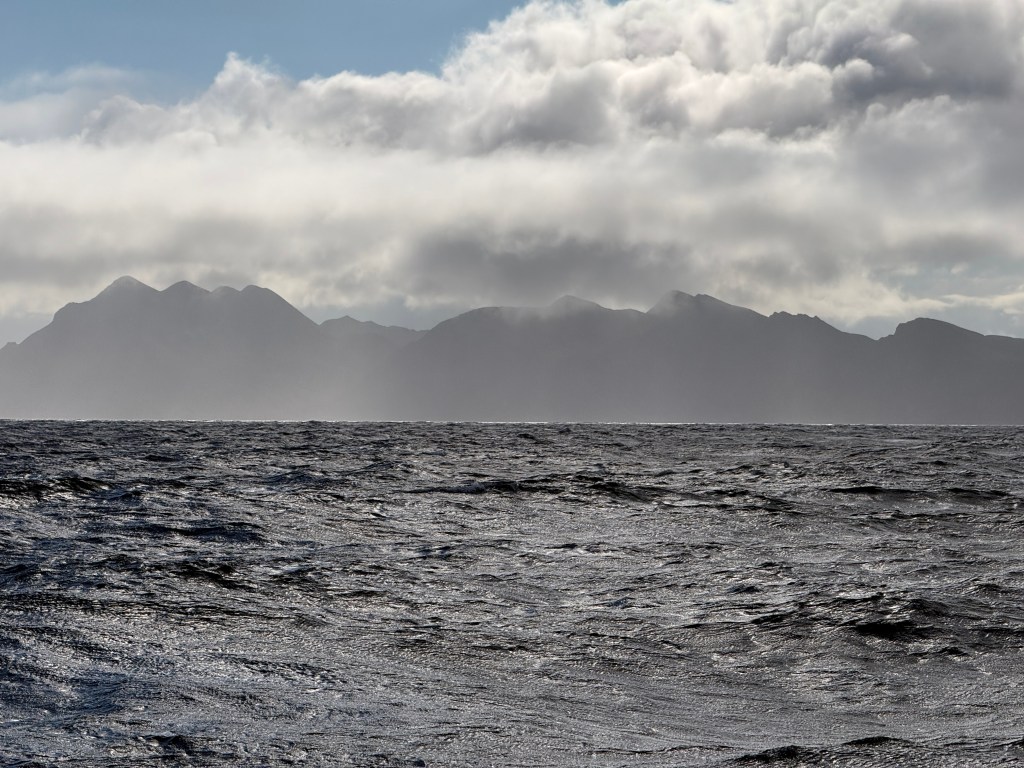
The color of the water changed from surreal sapphire blue to a more menacing steely grey. Fog cut our visibility down to a few hundred feet, but when it lifted enough to get a glimpse of land in the distance, everyone came back to life. The kids came outside for the first time in days. We started to hear the sounds of seabirds and the breath of whales. We noticed the clean, salty scent of sea air, which you only smell close to land. As we got closer, the hazy grey profile of the mountains moved towards vibrant emerald green, like someone was slowly sliding a saturation button. Despite being almost 2,000 miles from Seattle, our senses started to detect something like home.


Now, about a week later, we have been completely charmed by Dutch Harbor. It could just be the exceptional physical relief we feel being back in a climate that allows sleeping under blankets. Maybe it’s circadion confusion from experiencing full daylight at 11pm. (Despite sailing west from Hawaii, Alaska’s Juneau-centric time zone means we set our clocks forward two hours.) Definitely, it’s some nostalgia leftover from Steve’s 1992 NOLS trip in the Talkeetna Mountains and the 2008 Juneau-to-Sitka cruise that convinced us to leave NYC for the Pacific Northwest. Probably, it’s because a small, friendly American island feels knowable to us in a way that a small, friendly Polynesian island never will. Whatever the reason, you know you’ve got it bad when you start searching available real estate ($4k for a duplex, $2.5m for a 28-bed multi family home).


Dutch Harbor is actually the name of the bay. The town is called Unalaska, as is the whole island. All of it is ridiculously beautiful. The natural environment is dramatic. Steep, snow-capped mountains covered in treeless, green tundra. Fjord-like bays surrounded by waterfalls. Otters, whales, bald eagles, puffins.


Aside from an onion-domed Russian Orthodox Church, the built environment is strikingly utilitarian. Colorful piles of fishing gear are stacked around town. Culturally, it’s surprisingly interesting. The area was fished by Unangax people in sealskin kayaks, colonized by Russians in search of sea otter pelts, passed through by gold prospectors, fortified by the U.S., bombed by Japan, and made famous by reality TV.


What makes Dutch Harbor really interesting, though, is the combination of a small, tight-knit permanent community with an absolutely massive international fishing industry. It’s both a remote, wild west frontier town and a prosperous commercial hub — the largest port in the nation by volume of fish landed. (90% of the business is Alaskan pollock that ends up in frozen fish sticks and imitation crab.) We were docked in the land of Uni-Sea, a subsidiary of a Japanese seafood giant with a campus that includes fish-processing plants, employee bunkhouses, the Grand Aleutian Hotel, Harbor View Inn, and most of the restaurants in town.


Everywhere we went in Dutch Harbor, we ended up in a conversation with someone who already knew that we’d just arrived on a small sailboat. There was the guy at the hotel desk who told us about the Wednesday night seafood buffet, the woman at the car rental/freight company who told us the local name for our dock (“the new ghetto dock”), the civil engineer/owner of a fish oil company who gave us a huge piece of just-caught halibut, the gift shop owner who keeps a couple of lounge chairs for visiting Coasties looking for a quiet place to read, the guy at the bar whose new puppy will arrive soon by ferry and who double-checked our boat’s name so he could pray for us.

It’s shocking that there aren’t a hundred small-town mysteries set in Dutch Harbor. It’s a perfect setting: an incredibly picturesque environment, a small cast of interesting locals with shared histories and varied politics, a constant stream of outsiders, and lots of potentially lethal fishing gear. Maybe once we get back home and miss writing this blog, we’ll start our own Dutch Harbor story. If so, these are some of the real people who will become thinly-veiled fictional characters:
George
There is one Customs and Border Patrol agent in Unalaska. He told us that we didn’t need to check in since we were coming from Hawaii, but came down to the dock to meet us anyway. If you’re picturing any CBP agent you’ve ever encountered before, George isn’t like that. George is more like Dutch Harbor’s laid-back docent. His welcome included where to get groceries, where to do laundry, and his favorite places to eat. He told us that some of the thousands of bald eagles on the island were nesting and warned us about getting too close since there’s no hospital on the island. He also said: “The police don’t have a lot do here, so try not to give them something to do.”
Later, when we went to check out George’s favorite restaurant, the Norwegian Rat Saloon, we found his CBP car in the parking lot. There he was at the bar, drinking a Coke near a big bell labeled “ring for service.” One more piece of local advice from George: don’t ring that bell or you’ll have to buy a round for everyone in the bar. But maybe do tell someone you don’t like so much to ring it.

Daneen
Daneen came over to our table to at the Norwegian Rat Saloon to say hello. George had told her about us and she wanted to know what we were up to, since she and her husband spent 13 years sailing around the world on their sailboat, Rose. She told us about the nasty seas at the Cape of Good Hope and how Dutch Harbor has changed since the 70s and 80s when the old Elbow Room bar was considered the second most dangerous bar in America.
It took a very long time for it to come out that Daneen owns the Rat, a busy spot with delicious fisherman-sized hamburgers, a stack of old pallets for feeding the bonfire, an incredible view, and lots of merch. She told us to keep an eye our for her husband, Andy, who’s always down at the dock, and not to worry too much about the bald eagles since the clinic is great at sewing people up.

Andy
Andy has a long grey pony-tail and isn’t allowed into the Norwegian Rat Saloon where he’d just get in the way of the girls who run it. He’d like to be out sailing, but Daneen wants to be home near the grandkids. He knows exactly how lucky he is to be retired with time to do whatever he wants on his own schedule: working on his sailboat, telling stories about friends who wrecked their boats after long nights of drinking, or offering advice to visitors like, “Bears are like people. Some are going to be curious about you, some are scared of you, and some are mean. Best to assume they’re all going to be mean.”
Dan
Dan is many things: a commercial diver, a licensed explosives handler, an underwater welder, a storyteller, a family man, a business acquaintance of our friend Kuhrt, who called him “one of the original cowboys up there that used to blow stuff up with dynamite.” Basically, a legend. He’s salvaged or removed the wrecks of 79 vessels over 58′ long. He is the guy who is called when everyone else has run out of ideas, or needs someone with an explosives license to sign the permit for the 4th of July fireworks show. Also, he aligned our engine to 0.002”.

AmzerZo
A few days after we arrived, another aluminum sailboat tied up at the dock. The boat is registered in the Netherlands, but they’d also come from French Polynesia via Hawaii and had to be towed into the massive Resolve Marine shipyard in Dutch Harbor due to engine trouble. When the guys at Resolve couldn’t figure it out, they called Dan, who fixed it. It turns out, the couple on board are semi-retired lawyers who specialize in investigating white collar crimes.

What a total pleasure to visit Dutch Harbor in the summer months when the grass is green, the days are long, and the people are so welcoming. (We probably won’t be back in winter when everything is brown and winds whip up to 100kts.) From here, we’re headed east towards Kodiak where we hope to meet some more Alaskan characters, both human and ursine.


Leave a Reply